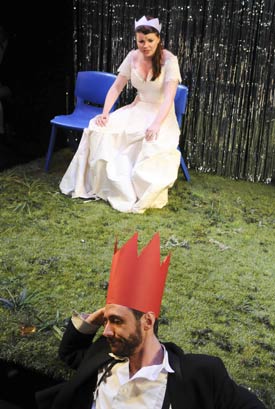
 Photos - Heidrun Lohr
This is the kind of Shakespeare we need to see: inventive, offbeat and irreverent, and yet with a clear dedication to working with and taking inspiration from the classic play rather than merely hanging some trite gimmickry onto a proven classic for the sake of tokenistic relevance and bankability, as some others very much seem to do.
While this production prunes the script in many places and even inserts quite a few original asides (along the lines of “get fucked”) here and there, the approach is one that is clearly very engaged with its text. Even the abundance of shtick that the actors deploy all comes across as serving their very credible portrayals of the characters and this production’s reading of what the play is all about.
Although it may not entirely live up to its advertised goal of being “a theme-party about shattered innocence and the restoration of grace”, this production amounts to far more than the sum of its unexpected gags, daggily dated power ballad pop, and curious pieces of stage business, suggesting a strong conceptual approach by director Eamon Flack. Even when the motivation behind certain directions is not always evident to the viewer, they give a sense of a comedic insight into the venerable play that is both intriguing and riotously funny. After all, who says you always have to have everything spelled out for you? Ambiguity is part of the fun.
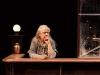
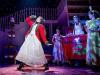
One of the intriguing aspects is this approach to the staging which is at once relatively bare-bones and also highly unpredictable, using only a small stage (even by Downstairs Belvoir’s intimate standards) laid with fake turf, a curtain and the occasional amusing prop, whilst only minor changes in costume details are used to signal character doubling. The focus, clearly, is very much on the talented ensemble and their performances, and the production also has a playbuilt feeling at times, as though enriched by considerable improvisation and exploration in the rehearsal process.
The doubling of the roles ranged from the conventional to the altogether unusual, with the expected conflation of the Theseus/Oberon and Hippolyta/Titania parts as well as the rarely-seen sharing of the Mechanicals and Lovers’ characters amongst the same small group of actors. Most curious of all was the doubling of scene-stealer Charlie Garber as not only Egeus and Bottom, but also Puck as well – an eccentric choice given that the latter two are both major roles, and even ones that briefly interact.
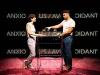
In light of this it seems particularly curious that the production also features two actors who only play small singular roles (ones that could have been doubled by a single actor at that) that require long absences from the stage, and yet strangely it all seems to work very well somehow. These odd choices (also including casting a man as Hermia and a downright bizarre closing moment with Peter Quince pashing his own hand in lieu of Puck’s famous speech) ultimately seem very organic to the show’s cohesively off-kilter approach.
The cast is impressive one and all, with Elizabeth Blackmore, Kit Brookman, Gareth Davies and Andrew Lees all playing their dual roles as neurotic Lovers and spazzy Mechanicals with equal aplomb.
Tim Spencer is very funny as a hopelessly nerdy Peter Quince while the sparkly Anya Poukchanski made a strong impression with her tiny role as the first Fairy we encounter.
Katherine Cullen impressed as both Hippolyta and Titania, all the more so given that she was essentially the only actor not given much opportunity to flex any comedic muscles, but fortunately still makes a mark with her considerable dramatic talents.
Tim Walter played some interesting nuances as Theseus but really excelled while playing Oberon as one half of an outright hilarious yet deliciously underplayed double act with Charlie Garber as Puck, putting a passive-aggressive spin on the master/servant relationship that resulted in even bigger laughs than some of the more grotesque comedy in the piece.
As mentioned, Garber steals many a scene, if not quite the whole show itself, in his roles as Bottom and Puck, as well as “himself” during a few moments when breaking the fourth wall to great effect. Although he might perhaps have made an even starker distinction between the two characters, Garber’s frequently uproarious performances are deftly executed, delivering some devastatingly funny turns in his fairly unconventional portrayals of these familiar roles. His was actually one of the most effective Pucks I’ve seen in quite some time.
If Shakespeare isn’t normally your bag, or you think it’s an odd inclusion in this year’s B Sharp season, think again. Even if you love this play but are sick to death of watching new productions of it year in, year out, this is the cure for what ails you. A smart, sexy, daggy, intriguing and frequently hysterical production that takes a fresh, engaging take whilst sticking to the heart of the play all the while. Highly recommended.
Arts Radar & B Sharp present
A Midsummer Night's Dream
by William Shakespeare
Directed by Eamon Flack
Venue: Belvoir St Downstairs Theatre, 25 Belvoir St, Surry Hills, Sydney
Dates: 26 November – 20 December
Times: Tues 7pm, Wed-Sat 8.15pm, Sun 5.15pm
Tickets: $29/$23 (Preview $20, Cheap Tues Pay-what-you-can, min. $10)
Bookings: 9699 3444 or www.belvoir.com.au